A Constant Stream of Information
We’re witnessing a social media landscape where everything is curated for you. You can log onto a given platform to swipe for hours uninterrupted. In this age of constant video flow, though, actively deciding what you want to consume might be the greatest power of them all.


I’m someone who overthinks many things. What book should I read next? Which TV show should I invest my time in?
This past week, I spent at least a half an hour looking for websites that could recommend me good television to watch. You might think that’s crazy and anal (which it definitely is), but in an age where everything is being force fed to you, maybe some custom cultivation isn’t such a bad thing.
So much of the content that is made easily available to us is like a stream (or TV…more on that later). It’s easy to step into the waters, but I find it increasingly difficult to get out. Social media is like a siren, calling with the temptation of “just 5 minutes” before you find yourself exhausted and still on the couch an hour later.
There are people making a lot of money off our tendencies toward the stream. There are financial incentives to capture our attention and hold it for as long as possible to milk more money out of us. This desire for more money is almost certainly why powdered greens are even peddled so widely on podcasts these days.
In a day and age where content is chosen for you (mostly via algorithm), it’s more important than ever to choose for yourself.
Struggling Against Temptation
This phenomenon of being inundated with trivial information isn’t new, but it's worse now than it’s ever been.
Maria Popova, in a recent Marginalia post, explores Nathaniel Hawthorne (author of The Scarlet Letter) and his journal to ask the question, “how can we avoid wasting our lives?” He wrote about how magazines of his time were filled with fluff, leaving readers empty afterwards. His description sounds eerily similar to what we’d consider brain fog today.
The peculiar weariness and depression of spirits which is felt after a day wasted in turning over a magazine or other light miscellany, different from the state of the mind after severe study; because there has been no excitement, no difficulties to be overcome, but the spirits have evaporated insensibly. – Nathaniel Hawthorne
In Hawthrone’s time, perusing trivial magazines was one way he thought life could be wasted (that was his age’s social media). Hawthorne believes that we’re doing ourselves a disservice by failing to grapple with any challenging information. We’re simply soothing over our brain instead of feeding it a diet that might inspire some sort of growth or change, which is ultimately our life’s purpose. We must find the thing we are to do with ourselves through the struggle.
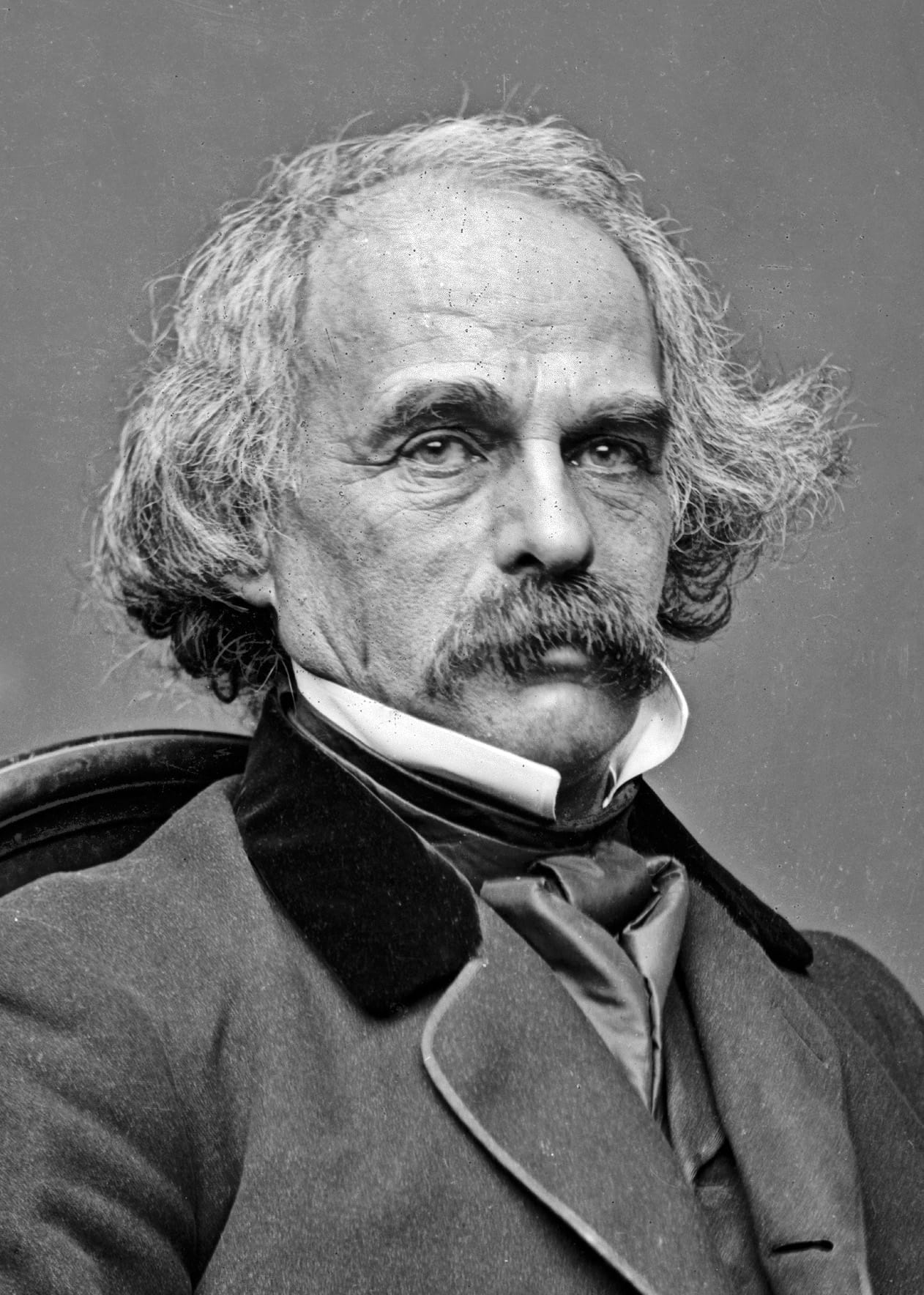
In a sentiment Nietzsche would echo a generation later in his insistence that “no one can build you the bridge on which you, and only you, must cross the river of life,” Hawthorne observes that we must each make that choice for ourselves and find our own place, seeing past the values of our upbringing, the templates of our culture, and the permission slips of our epoch. – Maria Popova
Ultimately, Hawthorne’s beliefs all play into the idea of shaping who we want to be, regardless of the numerous external factors that the world around us imposes. No one is going to come rescue us. We must put in the work ourselves.
It’s oftentimes easier simply to go with the flow, but Hawthorne would believe that’s a failure to oneself. We must press against a world trying to control our attention in order to hear our own inner voice whisper a way forward.
Who’s Behind the Attention Economy?
We’re constantly being inundated by dozens of sources all fighting for attention and attempting to convince us that they’re important. I could only imagine what Nathaniel Hawthorne would say if the magazines of his time were as addicting as social media, shaping the stories to each individual reader.
Kyla Scanlon, an economist and writer, frequently talks about how this attention economy has blossomed into a real beast in recent years.
When information is power and attention is currency, of course the people with the most money will try to buy the most influence. – Kyla Scanlon
During a post series on social media, I talked about how the goal of most social media platforms is to get you to spend money. That’s why the TikTok Shop exists. That’s why some influencers make so much money. You don’t have to swipe very far on any given social media platform to witness somebody somewhere trying to sell you something. Social media has an influential power over us, and not just when it comes to purchasing.
Why does this matter? Because controlling the means of mass communication means controlling the narrative. It’s the attention economy version of a monopoly. When one person (or a small elite) owns the newspapers, the TV stations, and the social media platforms, there is no room for alternate voices. – Kyla Scanlon
It’s all about control. We’re seeing this trend of consolidation amongst some of the biggest companies in America. Paramount is looking to purchase Warner Bros., which would combine two of the largest entertainment companies in Hollywood. AWS recently went down, revealing just how much of the internet relies on Amazon to be up and running. All this consolidation plays directly into who controls the (social) media we consume.
John Oliver recently did a deep-dive on the new Paramount owners and the changes they’re making to CBS News (which includes having a new editor-in-chief with hardly any journalistic experience). Jeff Bezos famously purchased The Washington Post. This consolidation amongst the biggest companies in America directly affects the things we consume on a day-to-day basis.
If this financial incentive to capture attention becomes only more appealing and accessible to billionaires, we’re going to have to fight that much harder to get out of its grasp. How should we feel about the wealthy elite controlling what, when, and how we consume the news and media?
Everything Is TV
All this is to say that our entertainment pipeline is becoming incredibly homogenized. Or as Derek Thompson put it, everything is becoming TV.
Raymond Williams wrote that “in all communications systems before [television], the essential items were discrete.” That is, a book is bound and finite, existing on its own terms. A play is performed in a particular theater at a set hour. – Derek Thompson
We’re slowly (or maybe not so slowly) watching every form of entertainment we consume become a version of TV. Thompson argues for 3 examples. First, social media (Meta is now arguing their platforms shouldn’t be considered social media because we hardly interact with people we know on it) is like television because it’s a feed of consistent content curated by someone we don’t know. Just like I might turn on ESPN (or not with YouTube TV and Disney beefing, another example of corporate influence) and watch whatever programming they have slated for that day, social media is similar.
Any one piece of content on TikTok is incidental, even inessential. The platform’s allure is the infinitude promised by its algorithm. It is the flow, not the content, that is primary. – Derek Thompson
Second, podcasts are like TV. YouTube has steadily become one of the biggest platforms for podcasts because so many of them now have video components. Most podcasts that come to mind are conversations between approximately 2 people. What’s the need to have such prevalent video content? Podcasts are becoming TV.
Finally, Thompson makes the argument that even AI is becoming like TV. This argument is somewhat similar to the social media one; platforms like Sora are aiming to be AI-generated social media platforms, and if you agree with Thompson’s take on social media becoming TV, AI is close behind. If ChatGPT has its way, not only will you have a custom-tailored algorithm to occupy your attention each and every day, but that content won’t even be made by a real person. It’ll just be someone’s prompt.
My beef is not with the entire medium of moving images. My concern is what happens when the grammar of television rather suddenly conquers the entire media landscape…Home-alone time has surged as our devices have become more bottomless feeds of video content. – Derek Thompson
As I’ve stated in previous posts on the topic, social media isn’t inherently bad. I do find myself aligned with Thompson’s concerns: that this shift toward the TV-ification of content is making us more isolated.
Away from Isolation, Toward Growth
If denying these temptations to uncover your true self as Hawthorne would encourage is the path to growth, isolation via social media (and other avenues) is a dangerous path toward stagnation or worse.
Is it not our duty to ourselves to uncover who we are? To spend the time (as hard as it may be) to figure out what that little voice in our head is commanding? We face an age where that voice is so easily quieted by a constant barrage of outside sources, which makes it more important than ever to stand strong against the headwinds of social media and big money to find the inner self.
The next time you find yourself turning toward some form of social media or content otherwise preconstructed for you, consider if it’s the best use of your time. I’m not saying to give it up entirely. It’s fun in moderation. It’s also a slippery slope, a pull toward a quickly flowing stream that wants to suck you in and never let you up for air, telling you what you should care about with each bend.
Pick what you want to watch, read, and enjoy. Pick because that’s your freedom. You have the freedom to choose.
If you’ve got a topic (a book, a movie, a song, etc.) that you want me to break down, leave a comment below!