Nihilism Isn't Cool!


I recently saw a video where I learned about an unfortunate new phrase: nihilistic violent extremist (NVE for short). This phrase was first used by the FBI back in March of last year.
According to PolitiFact, the term is used by federal law enforcement officials to “describe perpetrators who don’t easily subscribe to one ideology but appear motivated by a desire to…’gamify’ real life violence.” The perpetrators don’t appear to have clear objectives compared to other individuals and groups who have caused violence historically.
There are arguments over how effective this label is. Some think it’s an accurate term to summarize a rise in incidents that are committed simply to cause chaos. Others state that using the term NVE is a “disservice to those who try to understand where threats are emanating from.”
I’m not here to argue the accuracy of this term, but the connection to nihilism stood out to me. In our modern world, nihilism seems to be growing in popularity, but it’s far from a helpful way to look at life.
What Is Nihilism?
For those of you who haven’t brushed off your Philosophy 101 textbooks in a while, nihilism is a branch of philosophy popularized by Friedrich Nietzsche. At its most basic form, nihilism is the belief that life is meaningless.
As with many branches of philosophy, there are flavors of nihilism (existential, moral, chocolate, etc.), but the most common explanation of it is that nothing matters. We cannot find meaning in our lives because it doesn’t exist.
As Marty McFly says, “this is heavy, doc.”
While nihilism isn’t inherently cynical, it’s hard to avoid that attitude considering some of its stances. After all, the fact that “nothing matters” can be a burden or a blessing depending on how you look at it.
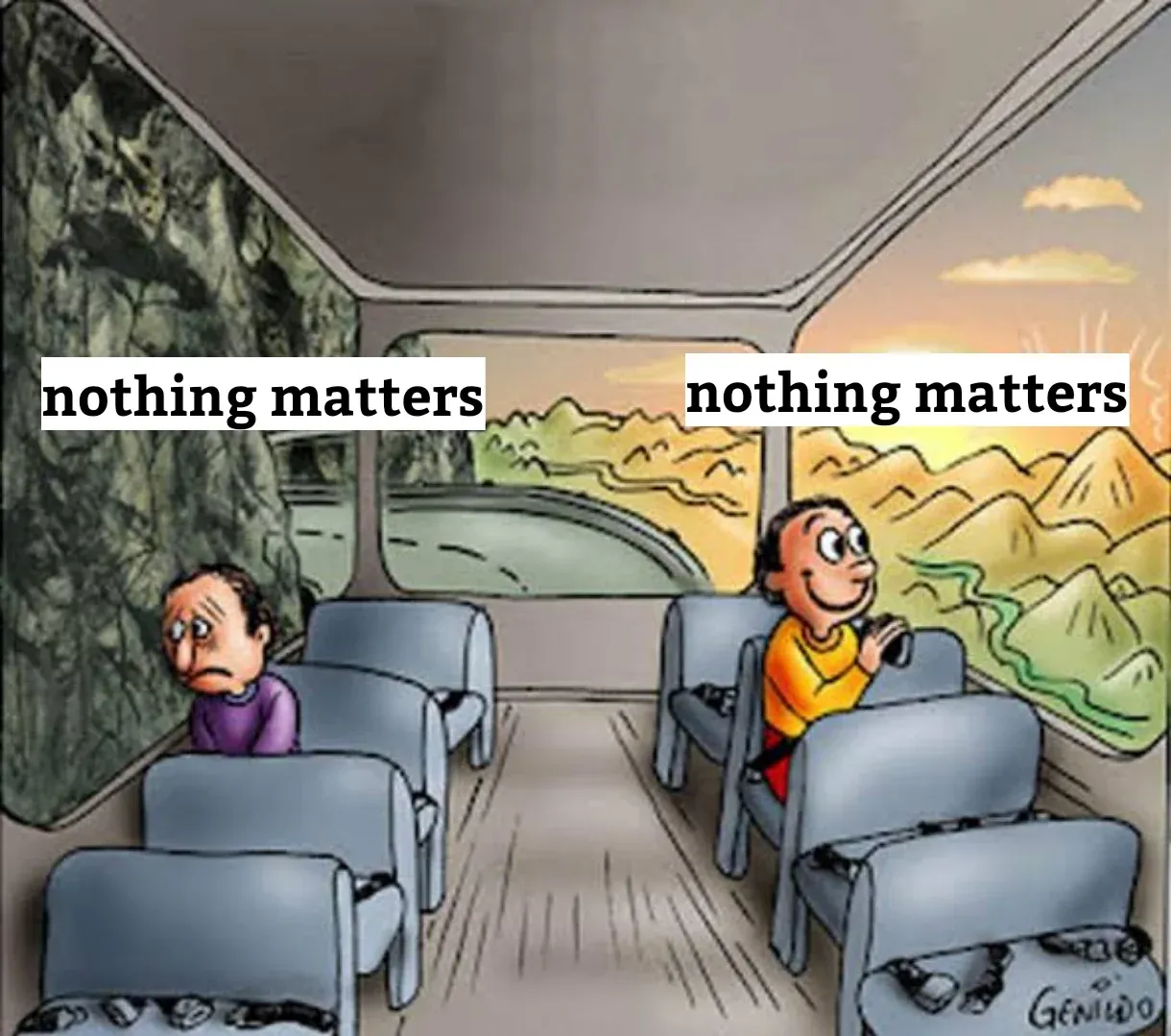
I worry that more and more people are taking the stance of the person on the left of the image.
Nihilism Sucks
Yes, nihilism might be a legitimate branch of philosophy, but I think it sucks.
Fortunately, I’m not alone in holding this belief. John Green, author and vlogger, agrees.
In a video addressing his stance on the subject, John states that “nihilism, like all straightforward answers to life’s great questions, is inadequate.” To throw up our hands and claim that “nothing matters” is far too simple an explanation for something as complicated as human existence.
“Something like 275 million stars are going to die tomorrow…it’s a little difficult to get excited about earthly affairs,” John concedes, but that doesn’t mean we should simply give up caring.
Human life is inherently imbued with meaning…if we so desire to find and apply it. John affirms, “what you do and who you care about, what and who you devote your soul-stuff to - when taken together - will be known as your life.”
The Asteroid Is Coming
In The Last Policeman, an asteroid is six months away from crashing into the Earth and ending human life on the planet.
It might be the only book I’ve read that qualifies as pre-apocalyptic. In the novel, life in the United States is bleak. The economy has crumbled, and faced with pending death, many people have stopped working and socializing or, worse, committed suicide. But not the protagonist.
When faced with a mysterious murder, Detective Hank Palace chooses to continue investigating. Everyone around him thinks he’s crazy to continue working when an asteroid is weeks away from wiping out everything, yet the detective continues.
Hank focuses on this work because it matters to him. He gives this work meaning.
My takeaway isn’t to dive blindly into your work, but rather we get to choose what gives us meaning. Maybe for you, that is your job. Maybe it’s something else. Maybe you live for tailgating during football season, or a cup of steaming coffee in the morning, or your child’s dance recital, or traveling the world. There are an unlimited number of things to care about; the only thing that matters is whether or not it’s important to you.
An asteroid might not be plummeting toward Earth this very second, but we each face our own individual asteroids, coming at some unknown time in the future. The universe might not have any opinion of us once our time passes, but while we’re here, we get to define what’s important to us.
We get to choose our own meaning.