Why I Go to the Movies: An Experience Streaming Can’t Touch
No matter how much money Netflix spends, streaming can't replicate the magic of seeing a movie on the big screen in a room full of people

Near the end of La La Land, the film takes its audience back to a familiar scene: Mia and Sebastian in a restaurant after the latter gets fired from his job as the in-house pianist.
We’ve seen this scene before. We know how it ends…right?
Mia, played by Emma Stone, approaches Ryan Gosling’s Sebastian to compliment him on his performance. Sebastian then blows Mia off, frustrated by how the evening went. The couple isn’t quite ready to fall in love.
Yet, when this scene replays near the film’s conclusion, it goes a bit differently.
Instead of rushing past Mia, Sebastian embraces her, and the pair kisses. The music swells. The restaurant’s patrons come alive to encourage the pair onward, through the life they could’ve had together.
The following roughly 8 minutes transfixed me as I watched the alternate ending, the one we didn’t get.
I remember the first time I watched it in theaters as my expectation was subverted by Sebastian not blowing past Mia. For those 8 minutes, I was in the movie. The screen took over my field of view. The music flooded my ears. I wasn’t in the theater anymore. I was in La La Land’s world.
That’s the power of seeing a movie in the theater: moments that transcend the silver screen.
These are also the kind of moments that just aren’t as memorable when you watch a movie on streaming.
The Ritual of Movie-Going
There’s always one big question on my mind when going to a movie: am I getting popcorn?
This is just one part of the movie-going ritual.
Going to a movie is an active decision.
With streaming, you can sit on your couch and poke around streamers for as long as you want before maybe deciding on something to watch. You have a whole closet of snacks available to you. You can pause the movie at any time.
When seeing a movie in the theater, you commit to going whether alone or with friends. You commit to buying a ticket. You know what movie you’re going to see before you even arrive. The planning makes the act more intentional. You’re not just letting some algorithm toss a bunch of ideas at you to see if something sticks.
Then there’s the previews.
I don’t think I’ve ever met anyone who doesn’t like watching the coming attractions ahead of the film itself. I love seeing these trailers and turning to whoever I’m with to give a silent positive or negative affirmation. The movies get added to a mental “I want to watch that” list.
All this adds to a certain fun urgency when it comes to watching a movie in the theater. You grab your snacks, hit the restroom beforehand, and catch the previews. You’re on a schedule. You can’t just hit pause whenever you want.
Going to the movies is a ritual.
What the Screen and Sound Actually Do to You
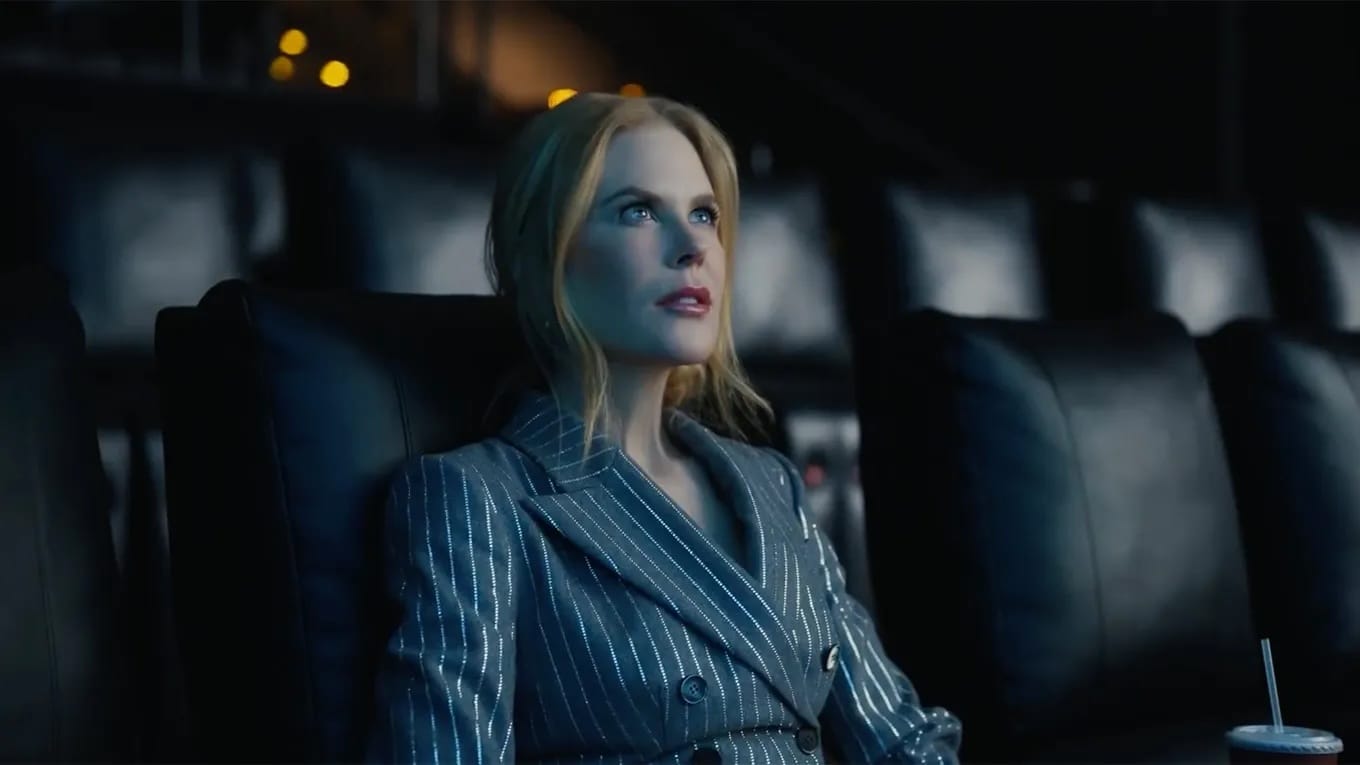
Once you’ve settled into your seats and made it through the previews, the lights finally dim. That’s when the magic begins.
When the film starts, there’s a certain awe that takes over the audience. The characters on screen are literally larger than life, and so are the sounds. You can feel the sound in a movie theater in a way that isn’t quite the same at home.
The screen and the sound make the experience.
Near the end of One Battle After Another, there’s a car chase where the vehicles appear and disappear over rolling hills. The camera situates itself under the front of a car so that we’re inches off the ground as one car chases another.
I started feeling myself get queasy during this scene as I watched it on the big screen. The perspective forces you into this dizzying chase sequence, and the effect is only heightened by being on the big screen.
The queasiness is exactly what Paul Thomas Anderson wants you to feel. He wants you to be in that moment with his characters. I’m not sure it would’ve had the same impact on me if I watched it on a smaller screen.
When you’re in a movie theater, you’re seeing, hearing, and feeling the movie as the filmmakers intended.
The Audience Is Part of the Movie
There are certain movies that demand to be seen with a large audience. Project Hail Mary is one of them.
Theaters were absolutely packed for the recent Ryan Gosling release, and I enjoyed the movie better for seeing it with a full audience. There’s a certain magic about journeying through space in a room full of people. Comedy in particular lands much better when there’s a crowd.
In Project Hail Mary, there’s the moment Gosling’s Ryland Grace starts to investigate potentially encountering an alien. He cautiously walks down the tunnel bridging the two ships. I could feel the tension in the theater. Dozens of people were holding their breaths as Grace stepped closer and closer to the wall in the middle of the tunnel.
And then Rocky smacks his hand on the window, releasing the tension and causing the audience to jump collectively. One person next to me kicked their legs up in the air at this moment.
That’s part of the experience I love.
We’re all different as people, but movies (and stories in general) speak to us on this primitive level. There’s a universal language that storytelling accesses. Tension in that moment affected nearly everyone the same way, just as certain jokes make the audience roar with laughter.
Seeing a movie with an audience reminds us what it means to be human. It reminds us that we have this shared mythology that can pierce us all in similar ways.
Why I Keep Going Back
Certain films just absolutely demand being seen with other people.
When it comes to music, you might have your favorite artist. You enjoy listening to their music on your phone, but it’s a vastly different experience when you get to hear that performer live with a crowd of people who enjoy it as much as you.
There’s a reason Taylor Swift’s tour made so much money. Communal experiences are worth the cost of admission.
Art isn’t something we have to experience in isolation. There are some forms that are more solitary like books, but even then, people congregate in book clubs to share the experience with others.
The rise of streaming raises some questions about the future of movie theaters. Maybe I’m naïve, but I think theaters will survive because I think there are enough people who enjoy the experiences I describe.
Movies are a communal artform like concerts, comedy shows, or ballet (shoutout Timothée). Experiencing a story communally is nothing new. It’s an experience that dates back to The Odyssey and earlier.
Movies are part of what makes us human. We need that piece of us like we need oxygen or water. We need places to enjoy a story together.
I’ll see you at the movies.
If you made it this far, please consider subscribing so that the next post gets delivered straight to your inbox!