I Think It’s Time for Me to End My Reading Challenge
I've spent years tracking every book I read. But chasing a number has quietly gotten in the way of why I started reading in the first place.


We’ve developed a focus on reading for volume in the 2020s. I have recently determined that this mentality doesn’t work for me.
Amazon and Goodreads have their annual reading challenge, where they emphasize setting a reading goal and trying to read as many books as possible within a year. (Isn’t that a coincidence that a bookseller wants you to buy and read more books?)
Book influencers make their careers touting how many books they’ve read and encouraging you to read (or more importantly buy) more books.
I mean just take a look below at some of the videos that pop up on YouTube:
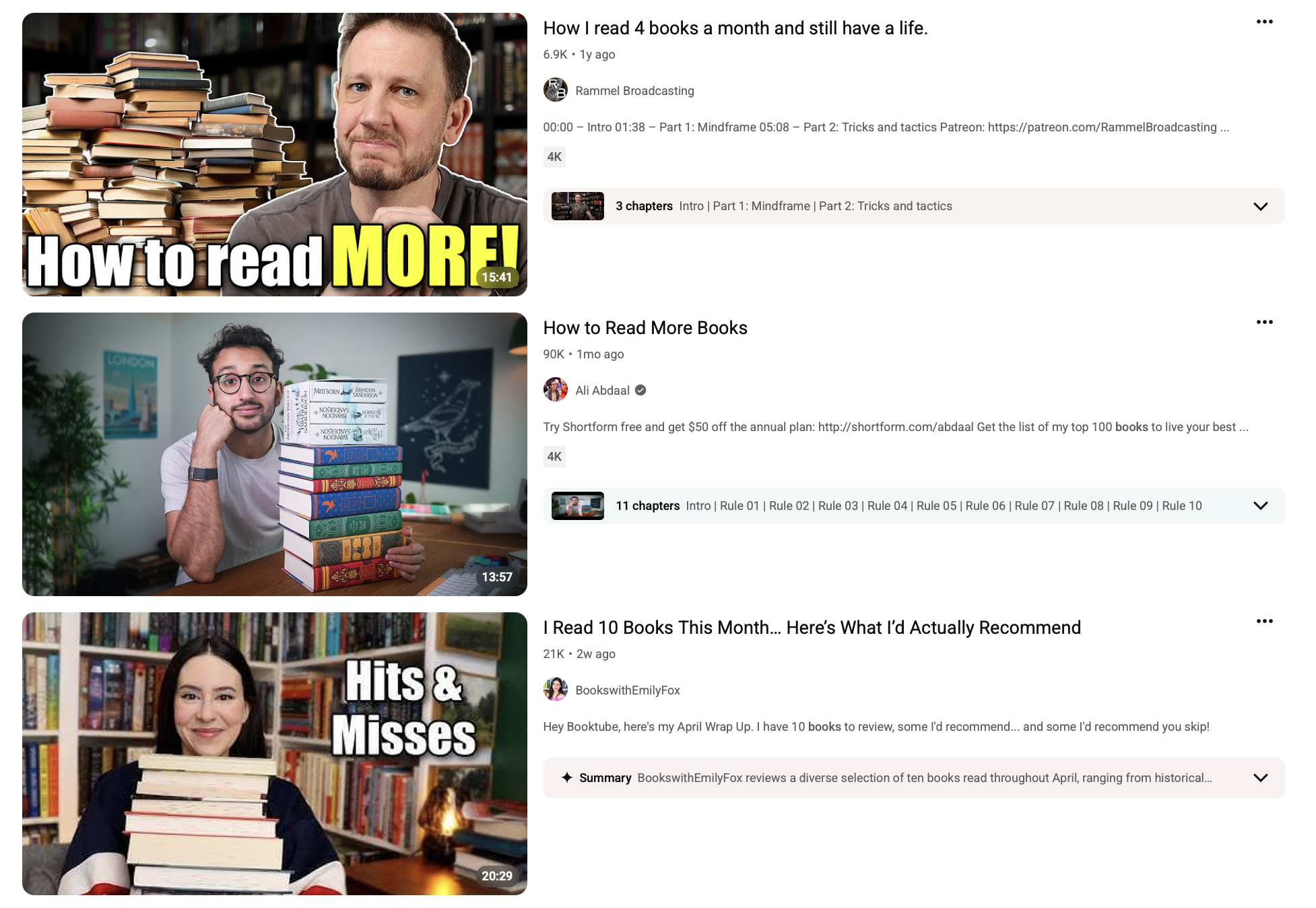
We’re so focused on more.
I guess I shouldn’t be too surprised. More is always better, right? More money, more power, and now, more books?
As I’ve re-established my love for reading as an adult, I’ve also re-evaluated my relationship with this focus on reading consumption.
The “more, more, more” mindset has to stop somewhere lest it become all-consuming. We only have so many hours in the day. At some point, more must transition into enough.
Reading a book is an experience to be savored, not a tally to be marked.
Learning Is the Outcome
There’s a notion rooted in elitism that a well-read person is more intelligent. The formula is simple: read more books, become a smarter person.
Volume isn’t the goal of reading, though. Or at least it shouldn’t be.
Learning is the outcome.
We read books to better understand something whether that be history, science, or the complexity of the human condition.
There’s no shortcut to understanding. If it takes re-reading a passage multiple times to grasp fully the topic at hand, that’s what we should do.
Learning takes its own time. It’s not something you can force.
If you’re on social media, you might’ve gotten an ad prompting you to replace your doomscrolling with “microlearning” via an app that takes books and condenses them into 15-minute bullet-point filled lessons.
That’s not how learning works!
You can’t replace decades of research with a 15-minute slideshow. Similarly, you can’t replace the emotional complexity of a Russian epic novel with a plot summary. You must do the work. You must sit in the complexity. You must go through the repetition.
If learning is the outcome, volume isn’t so important. It’s about what you take away from the books, not the number you conquer.
Bounce Around
You aren’t meant to enjoy every book you read.
When I’m tracking the books I read for a challenge, though, I feel much more committed to staying with a book. If I don’t finish the book, it doesn’t count!
That’s a recipe for hating reading.
That style of reading is like ordering a meal at a restaurant, realizing you hate the food, but feeling obligated to finish it regardless. Don’t eat that meal (unless it’s vegetables…you should probably eat your vegetables even if you don’t like them).
Instead, treat reading like a buffet. Try a little bit of one genre, see if you like it. Sample another genre. Find things you like that are new to you. Pick up some of the stuff you know you like.
As you explore a reading buffet, you’re likely to find things you never expected to like in the first place.
Pick up a book. Try it. Hate a book. Hate more books. That might lead you to finding one you love even more.
Hyper-Optimization Is Boring
I understand the desire to want to catalog every book you read. When I note that I’ve read a book on Goodreads, I feel like I’m filing it into some ethereal library that ensures it will remain a part of my soul for the rest of time.
Cataloging my life in this way is tiring, though.
We’re not a science experiment; we’re human beings. Our lives our imperfect. We’re going to forget things. That’s ok because if we forget something, it probably wasn’t worth remembering in the first place. Not every book needs to be stored into our soul library.
As I’ve written more over this past year, I’ve noticed that certain ideas stick in your mind. An idea will plant itself into a corner of your mind and demand to be explored. There are certain things you can’t forget about even if you try. Focus on these things.
Our brains are magical. They’ll make connections we could never expect, but they also need time to think and ponder. Tracking a book won’t make it count any more than a book that you don’t track.
Stop trying to hyper-optimize your life.
And if you want to know what book a friend is reading, ask them! Listen to them talk about a book they love or hate. I’m sure they’ll be more than happy to tell you about the latest stop on their reading journey.
On the Other Hand
Reading streaks and this focus on volume isn’t all bad. I do think looking at volume is a good way to get into reading.
When I got myself back into reading after college, I set volume-based goals for myself: I picked a goal for an annual reading challenge, and I tried to keep my Kindle streak alive by reading a little each day.
Those goals ultimately did motivate me to reform the habit of reading, which was important at the time.
If you aren’t currently reading, picking the habit back up can seem daunting. There are so many potential books to read. I get it.
A volume-based goal might be able to help you. If you only read 2 books last year, and you want to read more, maybe shoot for 4. If that’s what it takes to get you back into reading, do it. But if you find that that goal is no longer serving you, drop it!
Sour Grapes
I am also a very slow reader.
There’s likely never going to be a year where I get close to reading 100 books, so maybe this post is me acting like I don’t want to read a lot because I can’t.
Maybe, but I don’t think so. There’s an even bigger part of me that is interested in the pursuit of knowledge.
Education should be the outcome. If anything, this emphasis on reading volume is a moot point. If you read a lot, amazing! Keep reading. This isn’t to say slow down or read less.
This is all to say that the goal shouldn’t just be a number. The number doesn’t really mean anything on its own, and reading is about much more than the count of pages or books you read.
More Than Page Count
There are many good reasons to pick up a book.
Maybe seeing this new wave of BookTok has inspired you to get back into reading, or maybe you’ve just been putting it off for a while now and want to change that.
Focus on what reading should be about, though. Reading is about learning, growing, experiencing the minds of another person through story.
It isn’t about page count.
A reading journey, like any other human journey, isn’t straight-forward either. Dip your toe into one genre and find out you hate it. Try a book recommended by a friend. Fall in love with books you never expected to like. Keep yourself open, and don’t be afraid to put one book down to try another.
There’s a reason the written word has been so enduring. We have a way to connect with our shared human condition through literature, just like with other forms of art. Reading is all about connection.
There is no finish line, but there will be some beautiful sights along the way. So, pick up that book you’ve been thinking about, and see where it takes you.
If you made it this far, please consider subscribing so that the next post gets delivered straight to your inbox!